

There are some companies that not only know what it means to be socially responsible but also try to be a shining beacon of social responsibility to the world. These companies know that the world is full of problems, and they aim to help. Here is a list of some companies trying to make the world a better place.

Socially Responsible Leadership Fails
The concept of socially responsible leadership is one that has become more prevalent in the corporate world. Papers like this one published in the Journal of Social Change have shown the importance of being responsible and caring, putting people over profit, and generally trying to leave the world a better place. However, there are still those corporations and businesses that just don’t seem to get it. Or, even worse, they’re not remotely interested in being responsible, instead choosing to mislead, lie, or manipulate employees or the greater public. We’ve compiled a list of three of the most egregious and embarrassing socially responsible leadership fails from the past 20 years.
Enron
In the early 2000s, few company stories rang louder or shocked more than Enron’s. The energy company was reaching unbelievable heights at the turn of the century. Following a merger in 1985 between Houston Natural Gas Company and InterNorth Incorporated, the company was led by Jeffrey Skilling. Under his reign, Enron soared above other businesses of its time. Its stock price reached $90.75 at its peak. The company was hailed for innovation when it opened Enron Online, which acted as a virtual trading site for its commodities. Enron even received acclaim as “America’s Most Innovative Company” by Fortune Magazine for six consecutive years. However, in 2001, it all came crashing down. It was revealed that Skilling and his cohorts had fooled officials, investors, and regulators by providing fake holdings. They engaged in off-the-books accounting practices. They even concealed enormous debt and toxic assets, and eventually, they were forced to declare bankruptcy. Socially conscious leaders hold honesty and transparency near to their hearts. Enron executive displayed a lack of care for their shareholders and employees.
Unilever
Though you may never have heard of them, Unilever is the seventh largest company in Europe according to the Economist. Additionally, they own over 400 brands, according to their company website. Its mission statement says, “Unilever has a simple but clear purpose – to make sustainable living commonplace.” Unfortunately, the truth lies far, far away from these words. In 2017, they were outed as touting horrendous labor policies. They caused injury to 600 workers due to mercury contamination from a faulty plant, as written about in Forbes. The company also was embroiled in a sexual assault scandal against African workers, first reported in the Irish Times. While Unilever may be publicly touting its commitment to sustainability, events such as these suggest otherwise. Socially conscious leadership is about providing secure employment and focusing on lessening the ecological footprint. Unilever’s missteps seem to be a direct contradiction from the company’s public comments.
Uber
The popular rideshare app was on the fast track to success until it received a litany of serious allegations in 2018. Reports of rampant discrimination against women and people of color, as well as sexual harassment and assault came pouring forth. Engineers within the company claimed they were held back from promotions due to systemic inequality. Additionally, many of Uber’s hired drivers are earning less than the minimum wage, and the company has been accused by the New York Times of using manipulative methods to increase the number of drivers on the road without raising labor costs. These allegations have proven to be more than substantive, resulting in major settlements and the exit of CEO Travis Kalanick. Creating such a negative, toxic work environment doesn’t ring true for socially conscious leadership. Instead, Uber should have provided its engineers and drivers with not only sustainable living, but safe conditions.
When we look at these companies’ failure to exemplify socially responsible leadership, what can we learn? It’s clear that when businesses try to fake ethics, it rarely goes well. Socially responsible leaders embody their politics and views, and always do their best to put people over profits. Though we aren’t all CEOs, we can still practice these habits in our everyday lives.

Socially Responsible Leadership Checklist
At Alpha Kappa Psi, we’ve spent a lot of time thinking about socially responsible leadership and how to grow our members as responsible leaders. This means assuming a leadership role with the understanding that your decisions influence your teammates, your organization, and the greater community, sometimes with permanent impact. As we explored this concept, we put it into practice and documented our thoughts to keep ourselves on track and accountable. To share these insights with our brothers and the world beyond, below is a checklist for evaluating or developing socially responsible leadership, broken down by our three key practices.
Active Learner Checklist
Being a socially responsible leader starts with the willingness and effort to continuously grow in knowledge, skill, and competence. This is what we call an active learner.
How does completing this checklist make you a more socially responsible leader? By digging into the truth of each task, a leader can see beyond personal or systemic bias to act with integrity. Working backward from a desired outcome keeps socially responsible leaders and their teams focused on the greater goal, not the resources at hand to achieve it. And by being capable of applying past knowledge to current situations, you think critically about your own future and the possibilities.
__Explore volumes of data to sort out the truth from the noise when researching issues, objects, or courses of action.
__Seek to understand the difference between a cause of an issue or problem and a symptom of an issue or problem.
__When planning a project, start from your desired outcome and work backward.
__When evaluating your success or failure, don’t consider just the results, but also what you learned.
__When faced with a challenge or hurdle, explore various solutions by applying what you’ve learned in the past to your present situation.
Principled Decision Maker Checklist
Principled decision making is an integral part of socially responsible leadership. This isn’t just the process of gathering information and weighing possible outcomes of a decision, but also accepting responsibility for choosing a course of action.
This checklist encourages a socially responsible leader to be both organized and resilient. Documenting your process, information, and rationale means keeping track of how and why a decision was made. Being strong enough to assume responsibility for the outcome means that regardless of success or failure, the individual can still grow and learn from each decision.
__Evaluate the short- and long-term consequences of a decision with regard to family, the community, and the planet.
__Study opinions about the right and wrong of human conduct.
__Involve others in the decision-making process for a broader perspective on both the problem and opportunities to solve it.
__Document the circumstances that led to the need for a decision.
__Record the outcomes and identify what could have gone better to improve future decisions.
Change Agent Checklist
The final key practice of a socially responsible leader is to work as a change agent. This means assuming the role of driving growth by shaping the thoughts and actions of others.
Working as a change agent requires gratitude, emotional intelligence, and thoughtful and humble oral communication, potentially with people who are very different from yourself. Emotional intelligence is essential to navigate these encounters positively and learn something from each one. As you continue learning, you can change the world in a way that can help everyone.
__Practice active listening to absorb others’ perspectives and fully understand their needs.
__Build trust with others by engaging them in opportunities to learn along with you.
__Take steps to organize and develop your team’s written communication.
__Leverage social media respectfully to motivate others to act on community issues.
__Be sensitive to different cultural settings and listen before you give advice.
Let this checklist serve as a constant reminder of all the ways we can grow and improve as socially responsible leaders. Mastering the habits and traits on this list might be the work of a lifetime, but as you take it on step-by-step, we know you will find many rewards along the way.

What is Socially Responsible Leadership?
Social responsibility is when one takes into consideration how their actions affect the world around them. Making the decision to pick up litter or donate to a charity that supports the common good are two ways people can be socially responsible. But what does it mean to be a socially responsible leader? Is it forcing those that follow you to pick up trash or donate part of a paycheck to a worthy cause? While these examples might sound good to some, it goes beyond making people follow rules. Truly successful socially responsible leadership occurs by fostering an environment where other people’s needs are placed above your own. Let’s discuss what this can look like at work, with friends, and with family.
Socially Responsible Leadership at Work
Socially responsible leadership while at work takes some insight into yourself, your company, and its culture. This starts with introspection as to how your daily decisions affect others and the environment. Author and C-suite expert Jeffrey Hayzlett points out that socially responsible leadership puts your people and your planet first, and that if you do so, profits will follow. The environment and employee treatment are growing concerns, especially when it comes to Gen-Z according to Forbes. This generation, as they join the workforce, wants to ensure companies are addressing social issues within their business plans. Things like addressing climate change, global poverty, hunger, and human rights weren’t always taught in business school, but it’s becoming a common discussion at universities today. While some business leaders might think this isn’t the best use of time and money, there is an upside. According to Double the Donation, 55 percent of consumers are willing to pay more for products that come from a socially responsible company. What does this mean in more practical terms?
The first thing that might jump to mind is donating to a worthy cause. It’s a great way to start, but you have to vet your charity and verify that choosing one or two NPOs is better for your brand than donating to many. The flipside of socially responsible leadership is internal. It’s making sure that your employees get the benefits they need to live a happy life. This means keeping an eye on work-life balance. You also need to think about providing benefits, like 401(k) matching, maternity/paternity leave, and plenty of sick leave. The happiness and satisfaction of your employees has a real benefit. According to Hodges Mace, 75 percent of employees say that they are less likely to leave a company when they feel cared for. This saves you money on training new hires and provides a 20 percent boost in productivity according to Zenefits. While being a socially responsible leader at work is good for the world, it can help your bottom line quite a bit, too.
Socially Responsible Leadership with Friends
If social responsibility is important to you and you want friends to join the endeavor, the best thing you can do is lead by example. Try not to preach about it as that might appear condescending, which could alienate your friends from the prospect entirely. For example, if recycling is important to you, make sure the recycling bins at home are in a prominent place so that friends and family can easily put their empty beverage cans inside. This shows that recycling is easy and something that they could do in their own homes. Another example would be to suggest carpooling or even taking a bike or walking when on a group outing. This can help reduce everyone’s carbon footprint with the added benefit of exercise. If your friends aren’t interested in being socially responsible, follow your ethics anyway. There is a good chance that just by practicing what you preach, your socially responsible attitude will sway some of them eventually. This is an effect called social contagion. As described in the Huffington Post, this is a phenomenon where habits and lifestyles rub off on those you surround yourself with, which means the more you practice social responsibility, the better the chance that your friends will, too.
Socially Responsible Leadership with Family
It’s never too early to teach socially responsible habits to your children. If you think your child might be too young to understand how social dynamics work, author and education expert Rick Ackerly disagrees. He reports on research that shows “children have been researching their social milieu for thousands of hours by the time they are 18 months and, therefore, have a pretty good sense of what another person wants and, furthermore, have a natural desire to give that person what he wants.” This indicates that you can introduce socially responsible concepts at any age. Whether you are trying to guide your children, nieces, nephews or grandparents–everyone can be involved. So, what does this look like? It could be asking your family to volunteer at a local green space and clean up litter. No matter the activity, it’s important to maintain an open dialogue with each family member so they understand the importance of their actions. If a family member doesn’t understand, listen. Not everyone will be on board, but explaining your vision for the future and how your family can help build that will go a long way in gaining support.
These days, it’s important for both businesses and individuals to show socially responsible leadership to benefit fellow humans and make the world a better place.
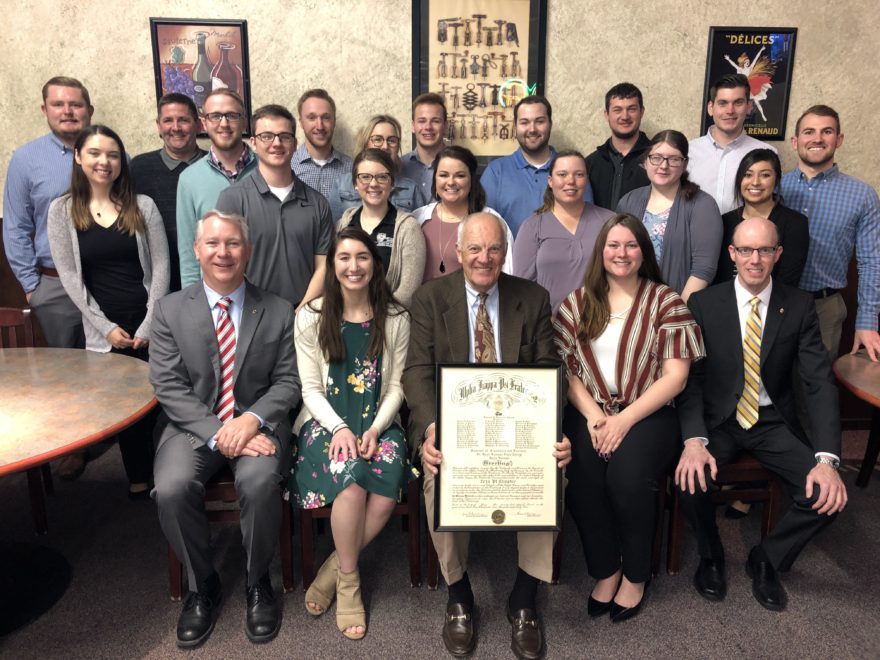
Zeta Pi Chapter Receives Surprise Visitor
Beginning in 1964, Jim Anderson and soon-to-be fraternity brothers paved the way for future students at Fort Hays State University by founding Alpha Kappa Psi’s 139th chapter, Zeta Pi. Chapter members received a special treat last spring when Anderson returned to his old stomping grounds.
Anderson said he visited his alma mater to have an opportunity to talk to students who are still abiding by the principles and values he put in place 55 years ago.
His visit began with a tour of campus and a walk down memory lane with current Zeta Pi chapter members. Anderson even gave a speech, detailing his career and the importance of a work-life balance, which he understands as a father of four.
“It was an incredible experience to connect with one of the founding members of Zeta Pi and to see and hear their successes after leaving the university,” said brother Kattie Jenik.
Jenik said the chapter hopes more alumni will visit and tell their stories to the student members who are still learning and writing the first chapter in their lives.
Since graduating in 1965 with a bachelor’s degree in business, Anderson began a long and impressive career in insurance, including a decade as the chief executive officer of Fremont Life Insurance Company from 1986 – 1996. He also spent time as the senior vice president of Americo Life, Inc., managing marketing and sales operations. Anderson is retired now, residing in Paso Robles, California.