
INDIANAPOLIS (March 4, 2019) – Atlanta, Atlantic City, Chicago, and Reno were home to Alpha Kappa Psi’s flagship event, Principled Business Leadership Institute (PBLI) February 8 – 10 and February 15 – 17. Find pictures from all PBLI events here.
INDIANAPOLIS (March 4, 2019) – Atlanta, Atlantic City, Chicago, and Reno were home to Alpha Kappa Psi’s flagship event, Principled Business Leadership Institute (PBLI) February 8 – 10 and February 15 – 17. Find pictures from all PBLI events here.
The date was February 8, 1949. Three new chapters had been installed the year prior, but 24 charters were pending approval from their respective universities. The concerns of Alpha Kappa Psi leadership grew each day that passed without a resolution from the universities where the futures of hundreds of potential principled business leaders were held in limbo. A decision needed to be made, and according to then Grand President R.A. Hills, it needed to be made quickly.
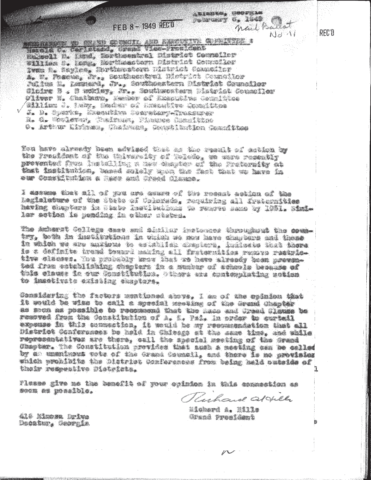
Mail Ballot, Past Grand President R.A. Hills.
To view the text of this image, click here.
The Fraternity Board of Directors received a Grand Council Mail Ballot from then Executive Director J.D. Sparks requesting a vote on whether to hold Grand Chapter (now called Chapter Congress) ahead of the Grand Chapter meeting already scheduled for 1950 to consider the race and creed clause.
Between the years of 1921 and 1950, the restrictive race and creed clause was part of the Alpha Kappa Psi Constitution. The clause read: “Members of Alpha Kappa Psi Fraternity must be men of the Caucasian race professing the Christian faith and shall be accepted and initiated into membership only by and through a college chapter.”
After weeks of deliberation by mail, the board of directors rejected the special Grand Chapter meeting proposal, claiming that moving hastily in a time of uncertainty was unwise. However, other Greek organizations also had a restrictive race and creed clause in their constitutions around this time and had made changes to the language in their governing documents as well. One Greek organization referenced in the minutes admitted only individuals who were “men socially and professionally acceptable,” per their edited constitution.

As a result of the board’s deliberation, the decision was made to include the vote in the 1950 National Convention Grand Chapter Meeting in Minneapolis, MN.

The morning was warm on September 8, 1950, in Minneapolis. One by one, the delegates approached the threshold of the meeting room, only allowed to take a seat after announcing themselves. At the time, each chapter of the Fraternity was allowed one delegate at the Grand Chapter Meeting. During Grand Chapter, delegates voted on legislation to amend the Constitution of Alpha Kappa Psi.
The Committee on Membership Requirements voted 11 to 2 to recommend that the restrictive race and creed clause be deleted from the Alpha Kappa Psi Constitution. The majority report was written by members of the committee who supported removing the clause completely from the Constitution while the minority report was written by those who also supported removing the clause from the Constitution, but subsequently, suggested it be added to the ritual manual.
Brother James P. Lucas of the Omicron chapter at Montana presented the majority report. With eight points of support, the recommendation was later accepted by the Grand Chapter to be voted on.
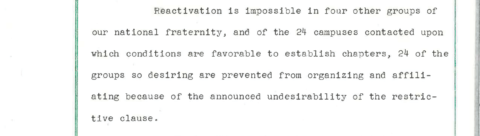
In the years leading up to 1950, 20 existing collegiate chapters were in jeopardy of losing privileges awarded to student organizations or becoming inactive on their respective college campuses due to the presence of the restrictive race and creed clause in the Constitution. In addition, 24 colonies in pursuit of an official Alpha Kappa Psi charter were put on hold or rejected completely because of the “announced undesirability of the restrictive clause,” as Brother Lucas noted in his recitation of the majority report.
Integrity, a core value of Alpha Kappa Psi since its founding in 1904, emerged as the overarching theme to the vote. Of the two options provided for removing the restrictive clause from the constitution, one would prove to be deceptive while the other would require the organization as a whole to stand with integrity in support of all men, even those cast out by many people within the United States.
During discussion of the majority and minority reports, a brother from Miami University stated that the restrictive clause showed a lack of confidence in a chapter’s ability to admit new members. Because members must vote on each pledge that requests admittance into the chapter, the restrictive clause proved redundant.

Proponents also argued that having the clause “hidden” would be dishonest and sneaky, ultimately putting into question the integrity of a person, a chapter, and the Fraternity.

Opponents suggested that removing the clause would prohibit the high standards of Alpha Kappa Psi and would extend membership to those who would not be accepted by all people of the country.

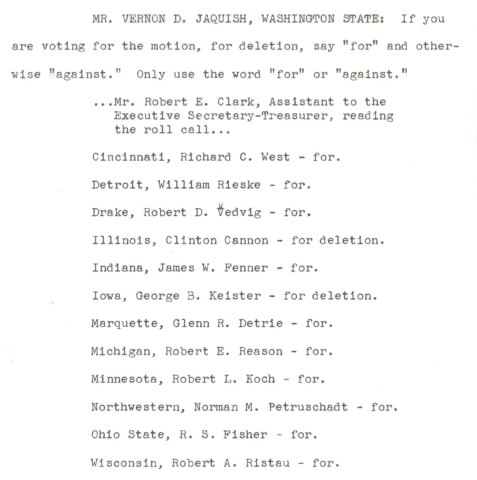
Of the 81 delegates present, 61 votes were required to pass the motion for removal of the clause. The motion passed 66 to 14. One delegate was not in the room during the vote.
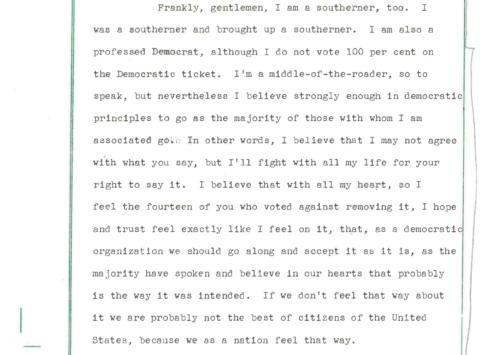
After the vote, various members expressed their opinions, with one brother stating, “…I may not agree with what you say, but I’ll fight all my life for your right to say it…the majority have spoken and believe in our hearts that probably is the way it was intended. If we don’t feel that way about it, we are probably not the best citizens of the United States, because we as a nation feel that way.”
2022 marks the 72nd year of the vote allowing people of color and people of any or no religious background to shape the Fraternity’s membership.
Diversity is more than a buzzword in Alpha Kappa Psi. Diversity is a value we choose to foster every day. Expanding our knowledge on a subject we are unfamiliar with allows us to enrich the membership experience. Our organization is the sum of its parts – each area, region, section, chapter, and member molds us into who we are. Is there a history of diversity in your chapter you could learn more about? How is your chapter celebrating diversity and choosing to participate in the conversation? Log into the MyAKPsi community to start a discussion.
Last Updated: February 21, 2022
Breaking the Barrier – The Inclusion of People of Color in Alpha Kappa Psi was originally written and published in February 2019.
 From games in the app stores that hone your thinking skills to professionals agreeing about the frequent need for critical thinking in the workplace, most people think that the upswing in analytical and critical thinking is a good thing that can even be fun.
What do these terms actually mean? How do you develop these skills? And how do they apply in everyday life?
Let’s start with definitions and work our way up to the application of these thought processes from the office to the home.
Critical thinking is the art of thinking well and improving the art of thinking. This is the kind of thinking that drives people to the top of Everest, around the world, and creates such things as Wikipedia. Today, it is often associated with thinking about hard problems or questions that really don’t have answers.
Analytical thinking, on the other hand, is a specific subset of thinking that is concerned with finding the solutions. Examples include the development of gear suited for the extreme conditions of Everest, faster and better traveling methods, and the actual answers that Wikipedia collects. A great example of this is the scientific method.
Because it is a subset of skills, you may find analytical thinking grouped under the term critical thinking. This is similar to comparing consumer math to math. However, for the purposes of this breakdown, the focus will be on critical thinking as it relates to theory and analytical thinking as it relates to practicality.
The office is one of the best places to practice critical and analytical thinking, with a few caveats. No one really appreciates a smarty-pants and most people have had the (dis) pleasure of dealing with someone like that. Think twice and speak once.
With that out of the way, critical thinking works best in situations and roles where you are planning for the long term. Examples include forecasting where a project should go using what you know now, looking for a better vendor or tool to implement in the office, or considering a department or career change.
Analytical thinking fills in the steps one takes to bring the theory to life. Creating a budget for a new project, testing a vendor or implementing a new tool, and researching where you would want to work next are all ways that analytical thinking would apply to critical considerations.
With friends, it can be more difficult to think at all, depending on the friendship in question. How long you have known each other and what you do together can influence your thought process about them. This can get in the way of any sort of thinking, let alone strenuous thinking!
However, analytical and critical thinking can still be done. Examples, where critical thinking can help in a friendship (or just on a night out), include planning the agenda together, making sure that you choose something that most of you will enjoy, and coming up with new places and experiences to try.
Analytical thinking kicks in (again) on the execution side of the equation, like calling to make reservations, remembering everyone’s dietary restrictions, or coordinating the carpool. Sometimes in a friend group, one more analytical thinker will come to the front to finish things up. Give your friend a hand when they need one because ideas come all the time, but experiences do not.
Depending on the type of family, siblings, fur babies, parents, and a thousand other factors, a family can be one of the toughest situations in which to use critical and analytical thinking.
The major upside of using critical thinking with members of your family is that it can help you consider the why behind old and new issues, situations, and unexpected new challenges that can crop up. Critical thinking enables you to look at a situation from different perspectives to make the best conclusion. Family provides us with a wide range of experience to draw from and can help us consider options we might not naturally. Where the analysis enters is in choosing to apply this insight. Thinking analytically can also help us stay focused on our goals with our family, instead of falling back into old emotional habits.
Critical and analytical thinking skills aren’t the easiest to acquire. In some cases, they can be some of the hardest skills to deploy when you want to. But just like any other skill, you must know what it is and how to practice it. You’ve got this.
 Joshua Silverboard, Florida ‘98, will begin the second day of the 2019 Principled Business Leadership Institute February 15-17 with a keynote address in Atlanta.

Al Baker, Minnesota ’09, joins the Alpha Kappa Psi community in a new role this year as an event presenter. Baker will kick off Saturday morning sessions with a keynote address at the 2019 Principled Business Leadership Institute February 8-10 in Chicago.